
How Comparative Negligence Affects Personal Injury Cases in California
June 3, 2026
Can You Recover Compensation If You Were Partly at Fault?
After an accident, many injured people assume they have no case once someone suggests they share part of the blame. Insurance adjusters often reinforce that belief. A few comments about speeding, distraction, or a split-second decision can quickly become the focus of an investigation.
California law, however, takes a different approach.
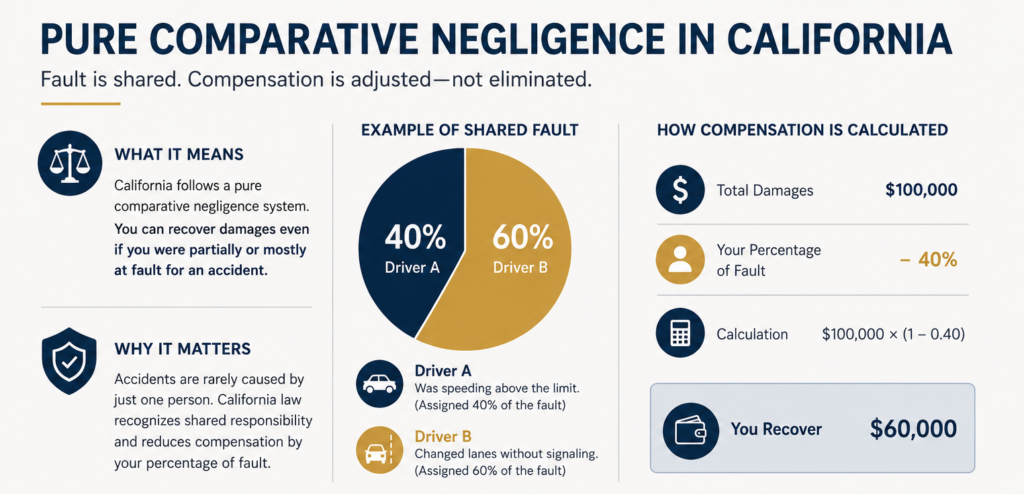
Even when an injured person contributed to an accident, they may still be entitled to financial compensation. California follows what is known as a pure comparative negligence system. Rather than preventing recovery altogether, the law reduces compensation according to the percentage of fault assigned to each party.
For accident victims, that distinction can make a significant difference. A person who is partially responsible for a crash, slip and fall, motorcycle collision, or pedestrian accident may still have a valid claim for damages.
Insurance companies routinely use allegations of shared fault to minimize payouts. The more fault they can place on the injured person, the less they may have to pay, so you will want to understand comparative negligence.
What Is Comparative Negligence?
Comparative negligence is a legal doctrine that allocates responsibility when multiple parties contribute to an accident. Instead of treating fault as an all-or-nothing issue, courts assign a percentage of responsibility to each person involved.
The injured party’s compensation is then reduced by their percentage of fault.
For example, if a jury determines that an accident victim suffered $100,000 in damages but was 20% responsible for the incident, the victim would generally recover $80,000.
This system recognizes a reality that often exists in personal injury cases: accidents frequently result from a combination of decisions, actions, and circumstances rather than a single cause.
Pure Comparative Negligence vs. Modified Comparative Negligence
States generally follow one of two approaches.
Pure Comparative Negligence
Under a pure comparative negligence system, an injured person may recover damages regardless of how much fault they bear. Even someone found 90% or 99% responsible may still recover the remaining percentage of their losses.
California is one of the states that follows this approach.
Modified Comparative Negligence
Many other states use a modified comparative negligence rule. Under those systems, recovery is barred once a plaintiff reaches a certain fault threshold, often 50% or 51%.
That means an injured person who is found primarily responsible may receive nothing at all.
California’s pure comparative negligence framework is generally viewed as more favorable to injury victims because it preserves the right to compensation even in difficult liability disputes.
Why California Adopted Comparative Negligence
California once had a contributory negligence rule, so a plaintiff who was even minimally at fault in an accident could be completely barred from recovering damages. However, the California Supreme Court rejected that approach in Li v. Yellow Cab Co., ruling that liability should be apportioned according to each party’s actual degree of fault.
The reasoning was straightforward. Holding people accountable for their actions remains important, but fairness often requires recognizing that responsibility can be shared.
Today, comparative negligence remains a cornerstone of California personal injury law.
How Fault Is Determined in California Personal Injury Cases
Determining fault is rarely as simple as reviewing a police report.
Insurance companies, attorneys, accident reconstruction specialists, medical experts, and witnesses may all play a role in evaluating what happened.
The central question is whether a party acted reasonably under the circumstances.
When fault is disputed, investigators often examine:
- Police reports
- Photographs of the accident scene
- Surveillance footage
- Dashcam recordings
- Witness statements
- Vehicle damage
- Medical records
- Cell phone records
- Black-box and electronic vehicle data
- Expert accident reconstruction analysis
Each piece of evidence helps build a clearer picture of how the incident occurred and who may have contributed to it.
Example of Shared Fault
Driver A is traveling above the speed limit while Driver B changes lanes without signaling.
A jury could determine that both drivers contributed to the collision. If Driver A is assigned 40% of the fault and Driver B is assigned 60%, any compensation awarded would be reduced accordingly.
If Driver A’s damages total $100,000, Driver A could recover $60,000.
The calculation reflects California’s effort to tie financial recovery to actual responsibility.
Can You Still Sue If You Were Partially Responsible?
In most cases, yes.
One of the most important aspects of California’s pure comparative negligence system is that fault does not automatically eliminate your claim.
You may still pursue compensation if you were:
- Speeding before a crash
- Distracted at the time of an accident
- Jaywalking when struck by a vehicle
- Not paying complete attention to your surroundings
- Partially responsible for a hazardous situation
The focus shifts from whether you were at fault to how much fault should reasonably be assigned to you.
That distinction often becomes the central dispute in a personal injury case.
How Insurance Companies Use Comparative Negligence to Reduce Claims
Insurance companies understand that every percentage point of fault matters.
As a result, adjusters frequently look for opportunities to increase an injured person’s share of responsibility.
Common tactics can include:
Seeking Recorded Statements
Adjusters often contact victims shortly after an accident when injuries, stress, and confusion are at their highest. Innocent questions can later be used to argue that the victim admitted responsibility or minimized their injuries.
Shifting Blame
Even when liability seems clear, insurers may argue that the injured person contributed to the accident by failing to act reasonably.
Challenging Medical Treatment
Insurance companies may claim that treatment was unnecessary, excessive, or unrelated to the accident.
Monitoring Social Media Activity
Photos, comments, and posts can sometimes be taken out of context and used to question the severity of injuries.
For these reasons, many accident victims choose to speak with an attorney before providing detailed statements or accepting settlement offers.
Common Examples of Comparative Negligence Cases
Rear-End Accidents
Rear drivers are frequently presumed responsible because drivers must maintain a safe following distance.
That presumption is not absolute.
A lead driver may share responsibility if they:
- Suddenly stop without justification
- Reverse unexpectedly
- Have malfunctioning brake lights
- Engage in aggressive driving behavior
Comparative negligence allows fault to be divided when both drivers contribute to the collision.
Slip and Fall Accidents
Property owners generally have a duty to maintain reasonably safe premises.
At the same time, visitors must exercise reasonable care for their own safety.
A jury might determine that a store failed to clean a dangerous spill while also concluding that the injured person was distracted and failed to notice an obvious hazard.
In that situation, fault may be allocated between both parties.
Motorcycle Accidents
California permits lane splitting, but riders must still operate safely.
Insurance companies sometimes argue that motorcyclists were traveling too quickly, weaving through traffic, or acting recklessly.
The specific facts often determine whether fault should be shared and to what extent.
Pedestrian Accidents
Pedestrians do not automatically lose the right to compensation because they crossed outside a designated crosswalk.
Drivers still have a duty to exercise reasonable care and remain alert to hazards.
Even when a pedestrian violated a traffic rule, comparative negligence may allow recovery if the driver’s conduct also contributed to the collision.
How Comparative Negligence Affects Compensation
Compensation in a personal injury claim may include:
- Medical expenses
- Future medical treatment
- Lost wages
- Loss of earning capacity
- Property damage
- Pain and suffering
- Emotional distress
Under California law, these damages are generally reduced by the injured person’s percentage of fault.
Consider the following example:
| Fault percentage | Recovery percentage | Example recovery on $100k |
| 0 % | 100 % | $100,000 |
| 25 % | 75 % | $75,000 |
| 50 % | 50 % | $50,000 |
| 90 % | 10 % | $10,000 |
| 99 % | 1 % | $1,000 |
The numbers illustrate why fault allocation can have such a substantial impact on the value of a claim.
Why Legal Representation Matters in Shared-Fault Cases
Comparative negligence cases often become battles over evidence and credibility.
Insurance companies may have investigators, adjusters, and defense attorneys working to reduce their financial exposure. Injured victims deserve an advocate who is equally committed to protecting their interests.
An experienced California personal injury attorney can:
- Investigate the accident thoroughly
- Preserve critical evidence
- Work with expert witnesses
- Challenge unfair fault allegations
- Handle communications with insurance companies
- Negotiate for full and fair compensation
- Present the case at trial when necessary
Perhaps most importantly, legal representation allows injured individuals to focus on recovery while someone else manages the legal process.
Speak With a California Personal Injury Lawyer
California’s pure comparative negligence system recognizes that fault is often shared and allows injured people to recover damages even when they contributed to the incident, but that doesn’t mean you should not pursue compensation. If an insurance company claims you were responsible for your injuries, fault determinations can be challenged, evidence can be investigated, and compensation may still be available.
A personal injury attorney is committed to providing clear guidance, honest communication, and aggressive advocacy for injury victims throughout California.
Contact AVA Law Group. When questions about fault arise, we work to ensure your story is fully heard and your rights are protected every step of the way.